Nothing that special. You take the SNPs, extract the first 7 or whatever principal components, and include them in the regression. To the extent that there's some population structure and subgroups are smarter/richer, it'll get controlled away. No guarantee that it'll work, but it apparently does (probably because most of the structure is in the first few components and including PCs beyond that is harmless).
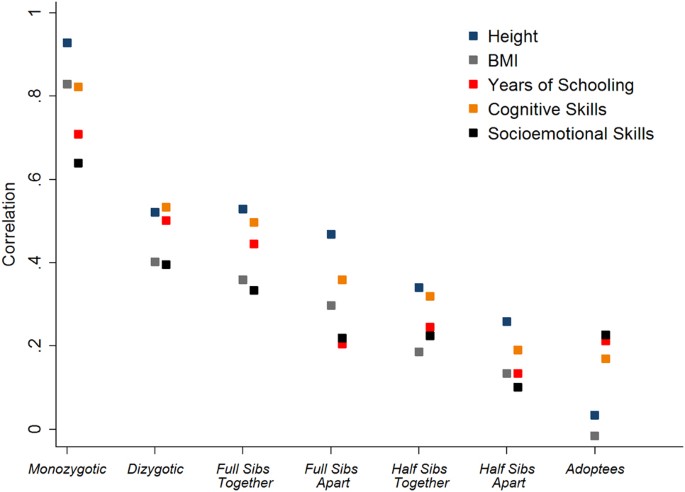
Somewhere around 70-80% of variance. People citing 50% as being conservative and generally ignoring measurement error and the heritability increasing with age. The latest GCTA methods, expanding the genetics considered but still far short of all genetic effects, turn in a lower bound of ~50% ("Genomic analysis of family data reveals additional genetic effects on intelligence and personality" http://biorxiv.org/content/early/2017/02/06/106203 , Hill et al 2017; "Comparison of methods that use whole genome data to estimate the heritability and genetic architecture of complex traits" http://biorxiv.org/content/early/2017/03/10/115527 , Evans et al 2017), so the true figure is definitely going to be much higher.
Researchers have conducted many studies to look for genes that influence intelligence. Many of these studies have focused on similarities and differences in IQ within families, particularly looking at adopted children and twins. These studies suggest that genetic factors underlie about 50 percent of the difference in intelligence among individuals.
Well, if you compare any human child with a snail you'll find that the human does almost infinity better at answering questions on IQ tests so we could say it's all genetic. Or we could take a sample of humans and feed the control group but not the other group over a course of a few weeks and see that environment plays a huge role. But over the range of upbringings we see in the US and genotypes we see in the US it's more genetic than not. But that doesn't mean that that's true across the globe. If some dirt farmer from a place with no iodine in the salt, no folate in the bread, and no access to modern public health, medicine, or schooling comes to the US their kids will tend to have an IQ something like 20 points higher.
It's a politically-charged question, so people tend to be very careful to ensure that whatever they say is correct. It's probably difficult to give a convincing argument in the space of an average HN comment.


This sounds really interesting, how does that work exactly?